
Why Choose Mayfair Health for Diagnostic Ultrasound?
- Integrated with your clinical assessment: Ultrasound is not a standalone add-on, it is used as part of a thorough clinical consultation, combining imaging with examination to build a complete picture
- Performed by your physiotherapist: At Mayfair Health, diagnostic ultrasound is carried out by your treating clinician, meaning findings are interpreted and applied in the context of your full clinical presentation
- No waiting for external imaging: Same-appointment scanning means you leave with answers and a clear treatment plan, rather than waiting weeks for an external appointment
- Direct access to specialist referral: Where findings indicate the need for further investigation or medical input, we have established relationships with leading sports physicians, orthopaedic consultants and radiologists to ensure swift, joined-up care
- Real-time guidance for rehabilitation: Ultrasound is also used therapeutically for real-time core and pelvic floor activation feedback, diastasis recti assessment and biofeedback-guided rehabilitation
What Is Diagnostic Ultrasound?
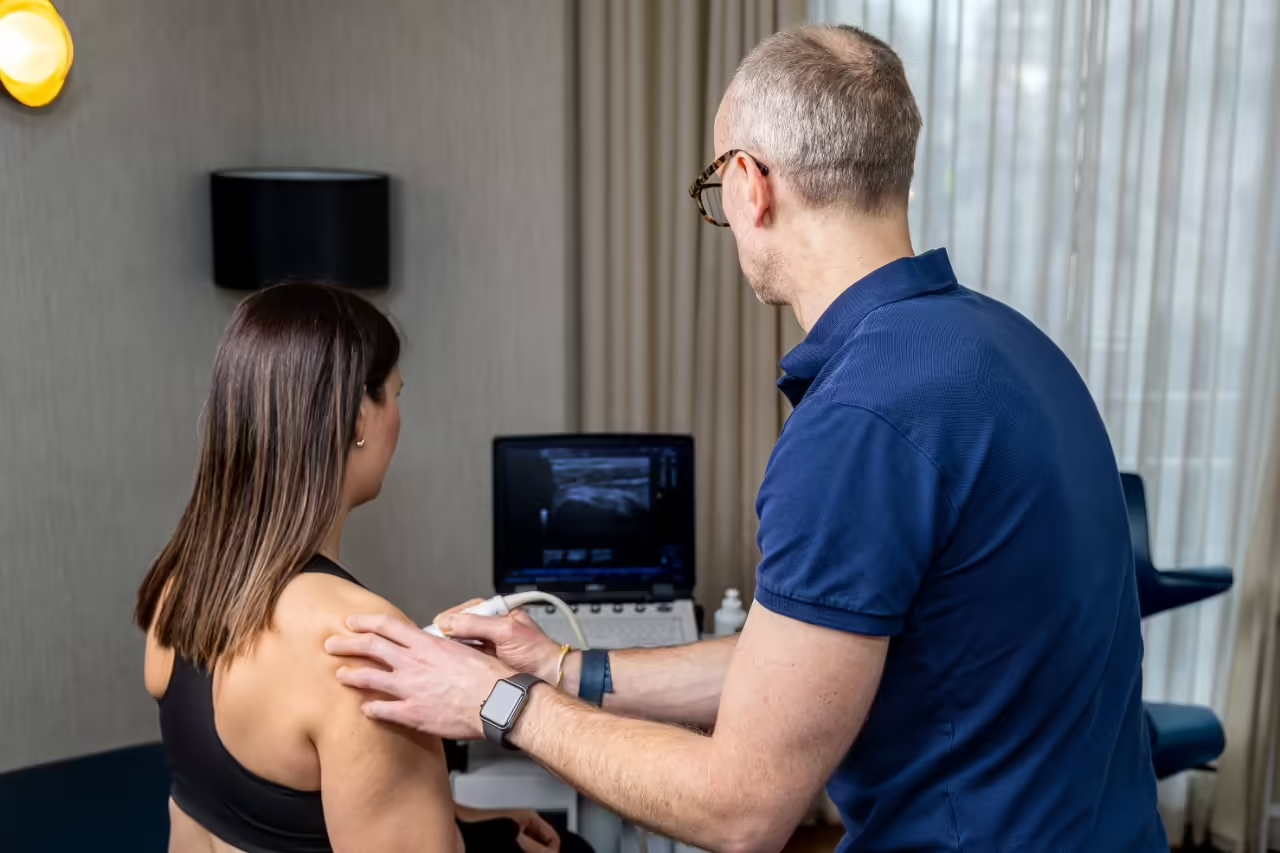
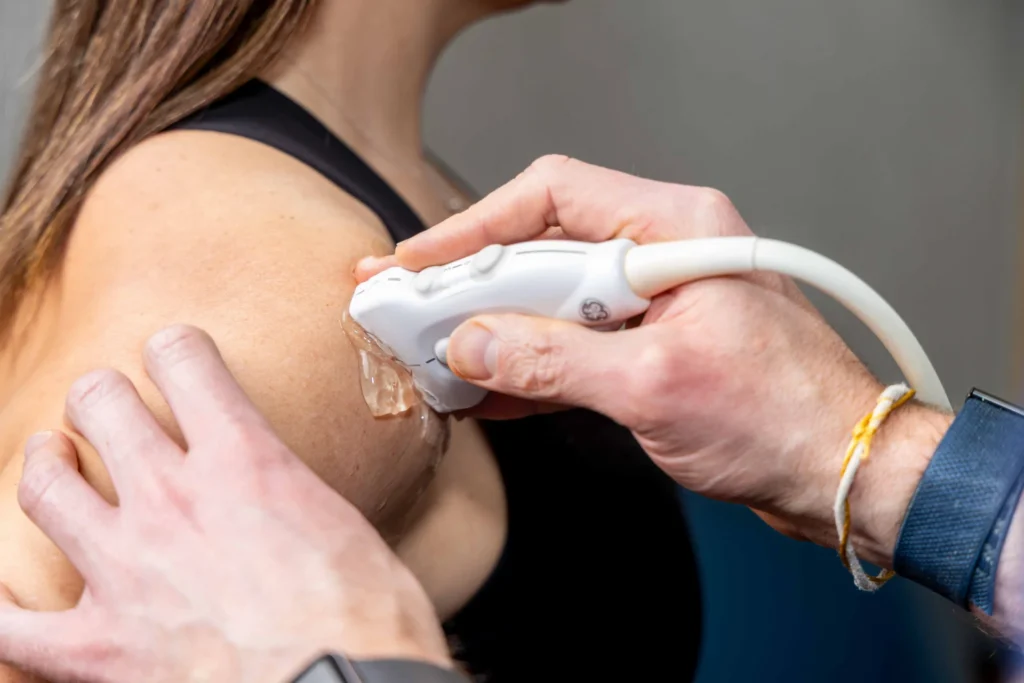
Diagnostic musculoskeletal ultrasound uses high-frequency sound waves to produce real-time images of soft tissue structures beneath the skin. Unlike X-ray or MRI, ultrasound is dynamic. It can show how a tendon or muscle behaves during movement, not just what it looks like at rest. It is safe, non-invasive, painless and produces no ionising radiation.
In a musculoskeletal setting, ultrasound is particularly effective for assessing tendons, where it can identify thickening, tearing, calcification and tendinopathic change with a high degree of accuracy. It is also widely used to assess muscle integrity, detect fluid collections and bursitis, and guide clinical decision-making around injection therapy or onward referral.
What Can Diagnostic Ultrasound Assess?
At Mayfair Health, diagnostic ultrasound is used to assess a wide range of soft tissue structures, including:
- Tendons: Rotator cuff, Achilles, patellar, hamstring, gluteal, biceps and other tendons – identifying tendinopathy, partial or full tears, and calcification
- Muscles: Assessment of muscle tears, strains, haematoma and structural changes following injury
- Ligaments: Ankle, knee and other ligamentous structures where ultrasound can contribute useful information alongside clinical testing
- Bursae: Identification of bursitis and fluid collections contributing to pain and restriction
- Nerves: Assessment of peripheral nerve thickening or entrapment in relevant clinical presentations
- Abdominal and pelvic structures: Real-time assessment of diastasis recti and core and pelvic floor activation as part of women’s health and postnatal rehabilitation
How Does It Work at Mayfair Health?
As Part of Your Physiotherapy Assessment
In most cases, diagnostic ultrasound is used within your physiotherapy appointment. Your clinician will carry out their usual clinical assessment and incorporate scanning where it will add meaningful information. You do not need a separate appointment or referral. The images are reviewed immediately, discussed with you in the room, and factored directly into your diagnosis and treatment plan.
Facilitating Onward Referral
Where ultrasound findings suggest the need for medical input, such as a significant tendon tear requiring consideration of injection or surgical management, or pathology that warrants MRI or specialist review. Your physiotherapist will use the imaging to support a prompt, well-informed referral to the appropriate clinician. Our established relationships with sports physicians, orthopaedic consultants and radiologists mean this process is fast and seamless.
Biofeedback and Rehabilitation
Real-time ultrasound is also used as a biofeedback tool in rehabilitation, particularly in women’s health, where it allows both patient and clinician to see pelvic floor and deep abdominal muscle activation directly. This is especially valuable in postnatal rehabilitation, diastasis recti management and core retraining following injury or surgery.
Conditions Where Diagnostic Ultrasound Is Commonly Used
- Rotator cuff tendinopathy and tears
- Achilles tendinopathy and rupture
- Patellar and quadriceps tendinopathy
- Hamstring and gluteal tendinopathy
- Plantar fasciitis
- Hip bursitis and greater trochanteric pain syndrome
- Shoulder impingement and bursitis
- Muscle tears and haematoma
- Ankle ligament and tendon injuries
- Calcific tendinopathy
- Diastasis recti and core rehabilitation
- Pelvic floor dysfunction and postnatal rehabilitation
FAQs
Frequently Asked Questions
Is diagnostic ultrasound safe?
Yes. Diagnostic ultrasound uses sound waves, not radiation. It is completely safe, non-invasive and painless. There are no known risks associated with musculoskeletal ultrasound scanning.
Do I need a GP referral?
No. You can self-refer directly to Mayfair Health. If ultrasound is clinically indicated as part of your assessment, your physiotherapist will discuss this with you at your appointment.
Is it the same as an MRI or X-ray?
No, each imaging modality has different strengths. X-ray is best suited to bony structures. MRI provides detailed imaging of soft tissue, bone and joints and is particularly useful for complex or deep structures. Ultrasound is dynamic, it can image soft tissue in real time, during movement, and is particularly effective for tendons, muscles and superficial structures. Your clinician will advise on the most appropriate imaging for your presentation, and can refer for MRI or X-ray where indicated.
Will ultrasound always be used in my appointment?
Not necessarily, ultrasound is used when it will add clinically meaningful information to your assessment. Your physiotherapist will discuss whether scanning is appropriate and beneficial for your specific presentation.
Can ultrasound be used to guide injections?
Ultrasound-guided injection is a specialist procedure carried out by sports physicians and radiologists, not physiotherapists. Where your clinical presentation and ultrasound findings suggest that injection therapy may be beneficial, your physiotherapist will refer you to the appropriate clinician within our network.
Is diagnostic ultrasound covered by private health insurance?
This varies between insurers and policies. We recommend contacting your insurer in advance to confirm your level of cover. Our team is happy to help with any queries.
Google Reviews
Check out our Google Reviews and see how we’ve helped others


 Trustindex verifies that the original source of the review is Google.
 Trustindex verifies that the original source of the review is Google.
 Trustindex verifies that the original source of the review is Google.
 Trustindex verifies that the original source of the review is Google.
 Trustindex verifies that the original source of the review is Google.
 Trustindex verifies that the original source of the review is Google.
 Trustindex verifies that the original source of the review is Google.

 Trustindex verifies that the original source of the review is Google.
 Trustindex verifies that the original source of the review is Google.
 Trustindex verifies that the original source of the review is Google.